Many people delay getting hearing aids because they don’t think they’ll like how they look or feel. That defensive reaction is totally logical from a consumer standpoint! In some cases, people even worried that they might be left out of conversation altogether by others who assumed they wouldn’t be able to hear or comprehend.
Consequently, this outdated, negative stereotype persists, preventing numerous individuals from seeking professional care. But the reality is that today’s modern hearing aids look and feel very different from what you might expect. Thanks to rapid technological evolution, modern devices are remarkably downsized, highly ergonomic, and exceptionally covert.
If you’ve been putting off treatment because of how hearing aids used to look, it might be time to take a fresh look at what’s available today!
The Hearing Aid You’re Picturing Doesn’t Really Exist Anymore
When most individuals conjure an image of assistive listening technology, they envision a massive beige plastic chassis hooked over the pinna and obvious to everyone nearby. Should that be your current expectation, you are inadvertently recalling the clunky designs common to the 1980s and 1990s.
Since then, the entire category has evolved. Exponential leaps in digital circuit shrinking, industrial design, and audio computing have totally redefined contemporary hardware. Today’s instruments are profoundly smaller, remarkably streamlined, and strategically engineered to blend flawlessly into your natural anatomy or vanish altogether.
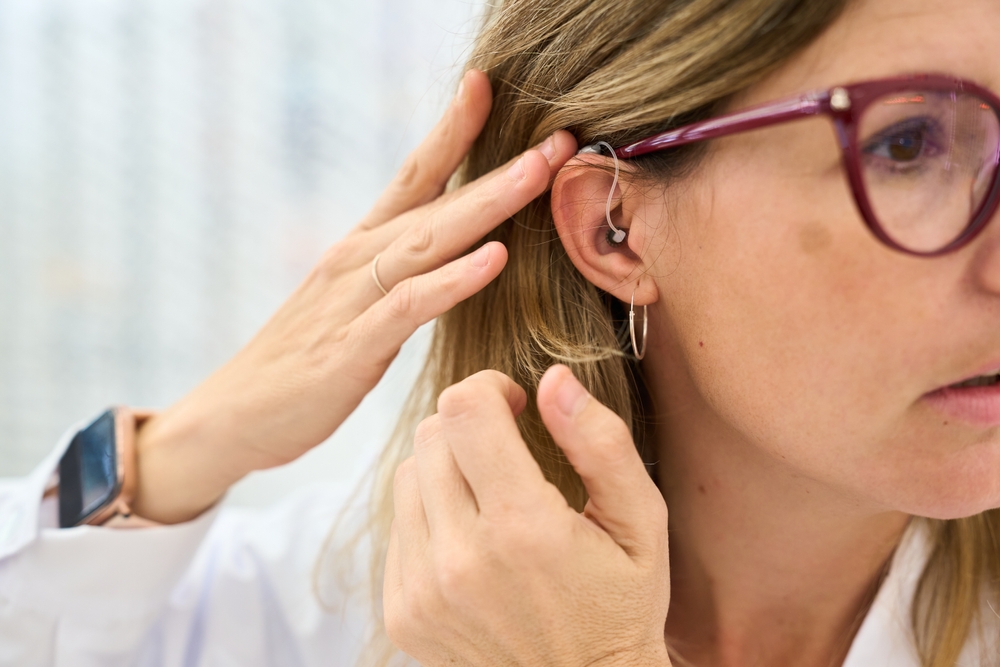
Numerous modern instruments are inserted completely within the ear canal structure, rendering them undetectable throughout standard daily dialogue. Alternatively, post-auricular models are constructed with such streamlined dimensions that they disappear against the scalp, customizable to complement individual skin and hair coloration.
Primary Hearing Aid Styles, From Invisible to Barely There
To understand how these sophisticated medical devices are physically configured, review this concise anatomical breakdown:
Invisible-in-Canal (IIC) Technology
These are as discreet as it gets. Engineered to rest deep inside the ear canal, IIC systems are individually molded to match the precise contours of your ear. During typical face-to-face communication, these custom models remain completely obscured from view. This configuration is highly favored by individuals managing mild-to-moderate auditory drops who demand total aesthetic secrecy.
The Versatile Receiver-in-Canal (RIC) / Receiver-in-the-Ear (RITE) Style
Statistically, this open-fit design represents the dominant choice among current consumers. A micro-housing rests behind the upper pinna, transferring processed sound via an ultra-fine, translucent micro-wire to an acoustic driver nestled inside the canal. To onlookers, this streamlined design closely mirrors fashionable consumer electronics or sports earbuds. Surrounding individuals will remain completely unaware of the technology unless they actively look for it.
Power and Performance: Behind-the-Ear (BTE)
These sit fully behind the ear and are slightly larger, but they’re still far more streamlined than older versions. They’re often recommended for more significant hearing loss and offer excellent performance without the bulky appearance people expect.
Ultimately, contemporary hearing aids are built to empower your daily routine rather than broadcast a medical condition to the world.
Modern Hearing Aids: Looking Better and Doing a Lot More
The evolution of these medical devices encompasses much more than a superficial face-lift. Contemporary devices are essentially miniature smart hubs rather than historical medical hardware. A vast majority feature native Bluetooth connectivity, enabling seamless, wireless streaming of telephonic communication, media, and television audio directly into your auditory pathway.
Equipped with dedicated smartphone applications, they allow users to manipulate volume matrices or toggle environmental programs without making manual physical adjustments. Say you’re walking into a noisy restaurant: You can fine-tune your hearing to match the environment in seconds. Convenient overnight charging systems have permanently replaced the tiny disposable batteries that patients traditionally struggled to replace. Just place them on a charger overnight, like your phone.
Overcoming the Psychological Barriers to Better Hearing
Even knowing all of this, it’s easy to hesitate. Scheduling an appointment can feel like a profound internal challenge because it represents an open admission of sensory alteration. This mental hurdle can make an individual feel exposed, creating a false impression of losing authority over personal wellness.
But here’s a different way to look at it: Hearing aids aren’t a sign that something has gone wrong. They’re simply a sign of change, which happens to us all. Adopting this tech is definitive proof that you are actively taking charge of your health to empower and protect your daily cognitive function.
Visualize the freedom of utilizing a completely covert acoustic system that restores your ability to track jokes, engage in crowded restaurants, and capture every nuance of the activities you love. That level of sensory restoration is incredibly liberating!
Discover the Reality of Modern Otolaryngological Solutions
To dismantle old assumptions, the best strategy is to witness these design breakthroughs with your own eyes. Our clinical team cordially invites you to visit our facility, interview our staff, and evaluate different form factors in a stress-free, zero-obligation environment. Consider it a chance to see and feel how different modern hearing aids really are.
The overwhelming majority of our patients leave their consultation thoroughly amazed by the compact scale, luxurious comfort, and acoustic clarity of current technology! Do not let outdated myths delay your wellness—call our specialized practice or book your appointment online today.